SEO vs GEO: How to Stay Visible When AI Answers the Question First
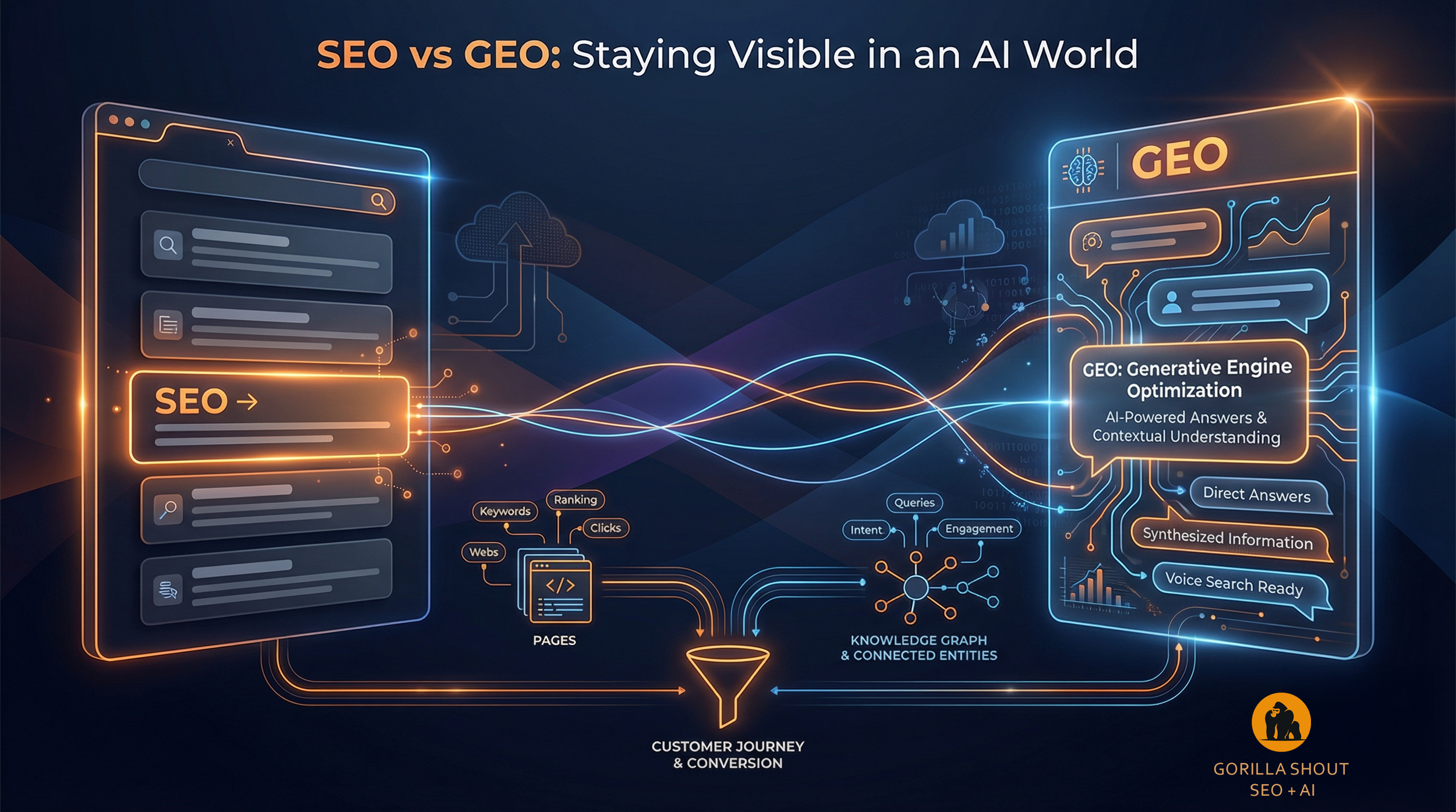
Diagram showing traditional SEO search results on the left and GEO AI-generated answers on the right, both feeding into customer journeys and conversions.
There’s a quiet panic running through a lot of marketing teams right now.
Search traffic is wobbling. Impressions look fine. The keyword reports still say you’re “on page one”… but when you Google yourself, there’s an AI box at the top answering the question before anyone even sees your link.
It feels like the rules changed mid-game.
If that’s you, this article is for you.
By the end, you’ll understand:
What SEO and GEO actually are (and how they’re different)
How AI answers are changing the way people discover brands
How to tell if you’re really losing visibility—or just watching the landscape shift
The practical steps a small team can take to stay visible in an AI-heavy world
Let’s start with the simple version.
What’s Changed: Search Now Has a Middleman
Old world search was straightforward:
Person types a question into Google.
Google shows a list of blue links.
They click one. You either won or lost that click.
Now there’s a new layer squeezed in between the question and your site.
AI Overviews summarize the answer right in the results.
“People also ask” boxes handle the follow-up questions.
Chatbots (Google’s AI, ChatGPT, Perplexity, etc.) answer questions directly without showing a classic results page at all.
The diagram below shows the difference between the old ‘results → click → website’ world and the new AI search layer sitting in the middle.

Figure 1 – Old search vs AI search.
In the old model, the user moves straight from results to your website. In the new model, an AI answer box often sits in the middle—and may be all they ever see.
Your site is no longer the first place people go for answers. At best, it’s one of the sources the AI pulls from. At worst, it’s invisible.
So the goal shifts from:
“How do I rank and get the click?”
to:
“How do I stay visible—even when an AI is answering for me?”
That’s where the difference between SEO and GEO comes in.
SEO vs GEO in Plain English
Let’s strip out the jargon.
SEO: Search Engine Optimization
SEO is everything you already know:
Researching keywords people search for
Optimizing pages so search engines can understand and rank them
Fixing technical issues, speeding up the site, organizing internal links
Earning links and authority over time
The goal: show up high enough in the results to earn the click.
GEO: Generative Engine Optimization
GEO is newer, but simpler than it sounds.
Generative engines are tools that generate answers instead of just listing links: AI Overviews, search chat, ChatGPT, Perplexity, etc.
GEO is the practice of making your brand and content:
Easy for those systems to understand
Trustworthy enough to use as a source
Structured enough to quote and summarize
The goal: become the material AI pulls from when it answers the question.
You still care about rankings. But now you also care about:
Being cited
Being mentioned
Being “the example” an AI uses when it explains how something works
Good SEO is still the foundation. GEO is how you package and prioritize that work for a world where an AI is the first voice the searcher hears.
Step 1: Check If You’re Losing Visibility or Just Losing Clicks
Before you tear everything down, you need to know what’s actually happening.
There are three different scenarios:
You’re still being seen, but fewer people click.
AI is answering enough of the question that some users don’t need to visit a site.You’re being replaced as a source.
Competitors or big publishers now “own” the space and are feeding the AI answers instead of you.You weren’t visible to begin with.
The AI changes just make a hidden problem more obvious.
A simple reality check:
Look at Google Search Console:
Are impressions relatively stable but clicks down? That’s likely scenario #1.
Are impressions dropping hard for key queries? Now you’re closer to #2 or #3.
Manually Google a few of your key search terms:
Do you see an AI box?
Is your brand mentioned, cited, or linked anywhere in that experience?
Do the answers sound like they came from content you actually have?
If you’re still visible in some way—rankings, mentions, citations—you don’t need a total rebuild. You need to tune your best assets so AI systems can lean on them more confidently.
Step 2: Make Your Best Pages AI-Ready (Without Starting Over)
GEO doesn’t mean creating 200 new articles.
Most businesses can start by upgrading 5–10 key pages:
2–3 core service pages
1–2 deep “pillar” guides on important topics
A strong “How we work” or process page
A compact FAQ or “Help / Resources” style page
For each of these, you want to make them easy for both humans and AI to use.
Here’s the checklist.

Figure 2 – What an AI-ready page looks like.
Clear intro, question-style headings, real examples, FAQs, and internal links make it easy for humans and AI systems to understand your page.
1. Start With a Clear, Direct Intro
In the first 3–4 sentences, spell out:
Who this is for
What problem it solves
What the outcome looks like
Think less “fluffy hero message” and more “plain English summary an AI could quote.”
“We help mid-sized B2B service companies build search visibility that actually turns into sales conversations—not just blog traffic or vanity rankings.”
That’s something a human understands instantly and an AI can slot into an answer.
2. Organize the Page Around Real Questions
Your subheadings shouldn’t just be “Features,” “Benefits,” “Our Story.”
They should sound like the questions people actually ask:
“How does [service] work?”
“Who is [solution] a good fit for?”
“What does it cost?”
“What happens if I don’t fix this?”
“How long does it take to see results?”
If a user or an AI wants a specific slice of information, those headings act like signposts.
3. Add a Simple FAQ Block
Take the 5–7 most common questions from sales calls and support conversations and add them to the bottom of the page.
Short questions. Short, clear answers.
This gives AI systems ready-made Q&A material to pull from. It also helps human visitors scan and get the quick hit they need.
4. Use Concrete Examples, Not Just Claims
Generic lines like “we deliver world-class results” don’t help anyone.
What does help:
A quick mini case study with before/after.
A specific scenario (“For a 20-person law firm, this usually looks like…”).
A couple of real metrics you’re comfortable sharing.
These are the things both humans and machines remember.
5. Connect Supporting Pages with Internal Links
If your service page mentions key sub-topics (pricing, tools, process, specific industries), link to deeper pages that explain them.
This:
Helps users keep exploring
Shows search engines how your content fits together
Gives AI more context and “evidence” to work from
Again, you’re not rebuilding the whole site. You’re taking your short list of essential pages and turning them into unmissable source material.
Step 3: Think Funnel-First, Not Keyword-First
You can’t GEO your way out of a funnel problem.
People don’t wake up one morning and search “best agency” out of nowhere. They move through stages:
Problem-aware:
“Why is my organic traffic down?”
“What is an AI Overview in Google?”
Solution-aware:
“SEO vs GEO”
“How to show up in AI search answers”
Vendor-aware:
“[service] for law firms”
“[agency] reviews”
AI systems are essentially funnel guides. They answer what’s appropriate for the stage the person is in.
If all your content is vendor-stage (“why our service is amazing”), you’re forcing users to leap from “I have a question” straight to “talk to sales.”
That’s where competitors slip in—by having better, clearer answers earlier in the journey.
A better approach:
For a problem-aware term, your page should explain:
What’s happening
Why it’s happening
What to check first
The basic options people have
For a solution-aware term, your page should:
Compare approaches
Show pros/cons
Explain how to evaluate vendors or tools
For a vendor-aware term, your page should:
Be crystal clear on fit, process, proof, and next steps
When you plan topics and pages this way, SEO and GEO line up:
Search engines see a complete content journey.
AI systems see a brand that has answers at every stage, not just a sales pitch.
Step 4: Use AI as a Power Tool, Not a Content Factory
One of the big fears right now is:
“If I use AI to help with content, will that hurt my SEO?”
The bigger risk isn’t using AI. The risk is using it badly.
The internet is already full of thin, generic AI articles that say nothing new. Search engines and users are getting very good at ignoring them. Check out our The Future of SEO: Radical Shifts and Strategies for 2025–2027 for more info.
A safer, stronger way to use AI looks like this:
Human chooses the topic, intent, and funnel stage.
You decide: “This is a solution-aware article comparing approaches” or “This is a BOFU page for our core service.”AI helps with structure and first drafts.
You can ask for:Outline options
Variations of intros
Idea lists for FAQs
Rough drafts for sections you’ll heavily edit
Human edits for truth, tone, and examples.
You inject:Real stories from your clients
Your actual process and nuance
Plain-spoken language that sounds like you
Final pass: structure for SEO and GEO.
You:Tighten headings
Make sure questions are answered clearly
Add internal links to related assets
Ensure CTAs match the funnel stage

Figure 3 – AI as a power tool, not a writer.
Humans decide the topic, intent, and voice. AI accelerates the grunt work so you can ship structured, SEO + GEO-ready content faster.
The result isn’t “AI content.” It’s your content, shipped faster, with the machine doing the grunt work and you doing the thinking.
How to Know When You Need Help
You don’t need a full-time SEO department to do this well. But you do need:
A clear view of where you’re visible and where you’re not
A plan for which pages and topics matter most
A way to keep content, CTAs, and funnel stages aligned over time
You might want backup if:
You can’t name your top 5–10 “must win” topics
Your reporting is all graphs and no decisions
You’ve got AI drafts—and no idea which are worth finishing
You feel like you’re constantly reacting to search changes instead of steering
That’s the gap Gorilla Shout is built for: treating SEO and GEO as one system, not a pile of tools. Diagnostics to see where you stand, strategy tied to your funnel, and an AI-assisted content engine that helps you ship pages, briefs, and campaigns in your own voice.
You Don’t Need to Beat AI. You Need to Feed It.
AI isn’t going away. It’s not a phase. It’s the new middleman between your customers and your content.
You don’t win by trying to fight that. You win by feeding it better answers than anyone else:
Clear, structured pages that explain who you help and how
Honest examples and proof instead of empty claims
Content that meets people where they actually are in the funnel
If you make it easy for both humans and machines to understand you, you’re already doing GEO.
And if you’d like help figuring out where you stand—and which pages deserve your attention first—that’s exactly what we built Gorilla Shout for.
Ready to see where you actually stand?
If you’re not sure whether AI search is quietly pushing you out of view, let’s find out. I’ll run a focused Visibility Check on your site and show you what’s working, what’s leaking, and which 5–10 pages deserve attention first.